Most of the incidents we see on Turkish trails are nothing dramatic. An empty bottle two hours from the finish, a 10 am start in June, a descent taken too fast on loose stone, a phone with a flat battery. This guide gathers what we tell our walkers before every departure, whether they walk with a guide or self-guided. For gear, see also what to pack for a trek in Türkiye.
How much water should you carry on a trail in Türkiye?
There is no single figure: it depends on temperature, exposure, duration and what you will find on the way. But one principle never changes. You work out the water you carry to reach the next reliable source, not for an "average" day.
These are the benchmarks we use. They are field benchmarks for a healthy adult, not a medical rule: some people drink more, and the heat on a sunny limestone slope is far above what the forecast says.
| Situation | Example | Water at the start (per person, benchmark) | Suggested start |
|---|---|---|---|
| Cool day, village halfway | Cappadocia in October, 4–5 h stage | 1.5–2 L | After breakfast |
| Mild day, no village | Lycian coast in April or late October, 5–6 h | 2–3 L | Early, around 8 am |
| Hot day, exposed slope | Lycian coast in June or early September | 3–4 L | At first light; finish in early afternoon |
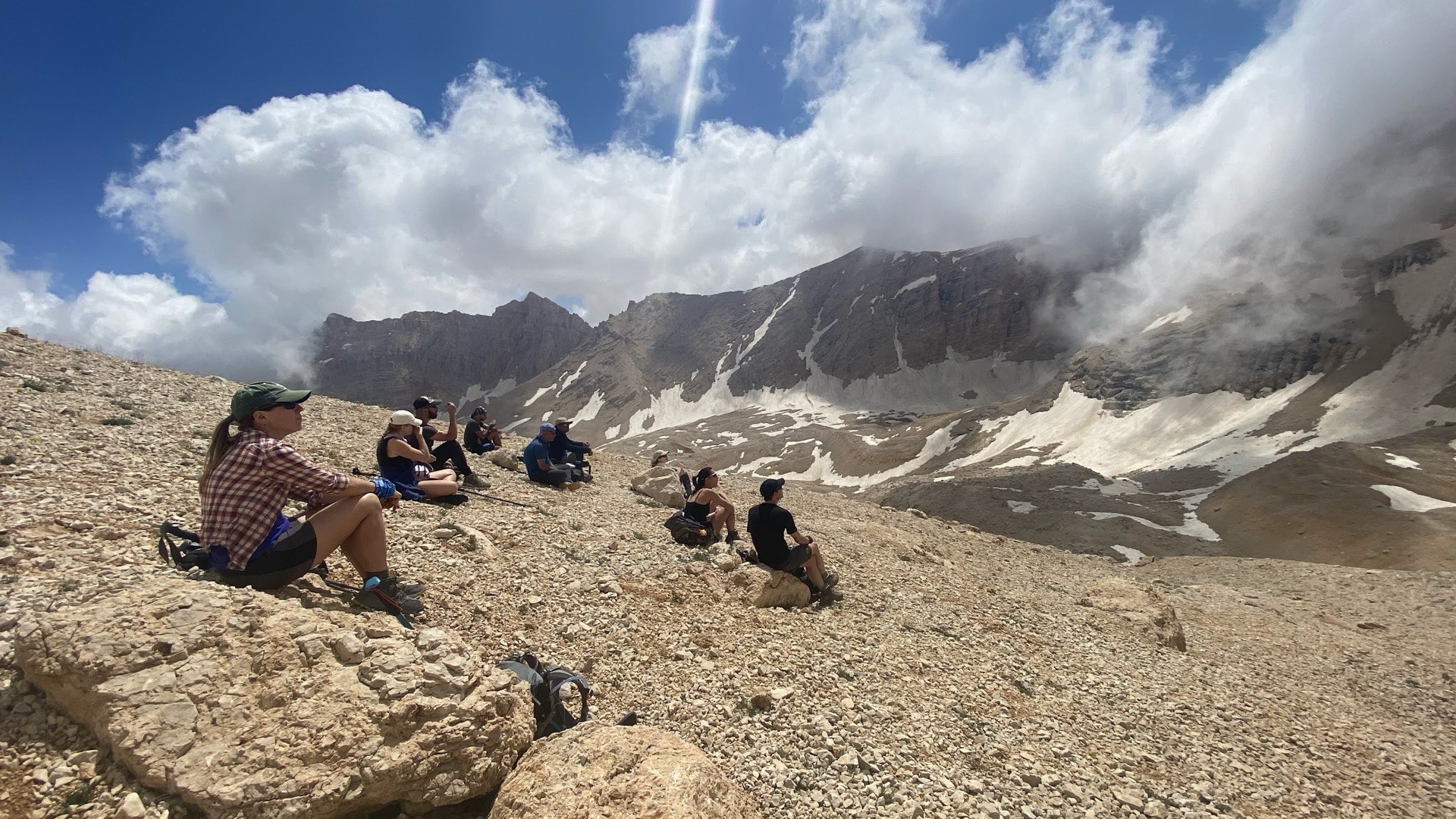
| Limestone (karst) mountains | Taurus, Aladağlar: few springs up high | 2–3 L, depending on confirmed springs | Early, to cross high ground before the heat and storms |
| Midsummer sun | July–August on the coast | We do not schedule long stages | — |
Always add a half-litre reserve that you do not drink until the finish is in sight. And drink regularly, in small amounts, before you feel thirsty.
Where to find water: fountains, cisterns, villages
In Turkish villages, the public fountain (çeşme) is part of the scenery: a stone trough, a tap, often an inscription. Many are fed by a spring or the village supply, and locals fill their jerrycans there. Ask whether the water is drinkable ("içilir mi?"): the answer comes quickly and is worth more than any map.
Between villages, it is another story. On the Lycian Way, ancient or shepherds’ cisterns (sarnıç) dot some sections. Their water is standing, sometimes warm, sometimes dirty: filter and treat it, never drink it as it is. Streams marked on maps are often dry by late spring. The Culture Routes Society says independent trekkers will find plenty of wild camping places with water nearby, but "nearby" does not mean "on the trail".
The Ministry of Culture and Tourism’s official Lycian Way site gives precise examples: after Kalkan, drinking water is available at the Bezirgan fountains; from Kaş towards Limanağzı, there is no village for supplies until the Boğazcık–Kılınçlı area; Finike is the best place for water, food and a bed on that stretch. This is the kind of information to look up for every stage before you set off.
In the limestone ranges of the Taurus, water sinks into the rock: up high, springs are rare and some dry up in late summer. On Cappadocia & Taurus, our guides know where they flow; on your own, only count on a spring if someone local has confirmed it is running this season.
Heat: timing, slopes and warning signs
Heat is the number one risk of hiking in Türkiye, far ahead of anything else. In July and August the average high reaches 34.9 °C in Antalya according to official MGM normals; in June it is already 31.6 °C. The Culture Routes Society puts it plainly: summer in Lycia is too hot for long walks. That is why our Lycian trips run in spring and autumn.
Even in those seasons, a south-facing limestone slope can turn into an oven around 1 pm. Our rules:
- start early, at first light on hot days, and do the main climb in the morning;
- take the long break in the shade during the hottest hours, by a cove or under an olive tree;
- cover your head and neck and wear light long sleeves, which also protect you from thorny scrub;
- slow down on sunny climbs rather than pushing.
Learn the early signs of heat illness: headache, nausea, cramps, extreme tiredness, dizziness, skin that stops sweating. At that point, stop in the shade, cool down and sip water. If the person becomes confused or loses consciousness, it is an emergency: call 112.
Fire season: what the rules say
Every year Turkish provincial governorships publish forest fire prevention rules. They matter to walkers, because the Lycian Way and most coastal trails run through pine forest.
- Antalya province (from Kalkan and Patara to Antalya): Circular 2026/3 of 4 May 2026 bans entry to forests from 1 May to 31 October 2026, except in areas listed in its annex, which include the Geyikbayırı–Çıralı stretch of the Lycian Way and designated trekking routes. It also bans overnight stays in state forests outside places designated by the forest administration.
- Muğla province (the Fethiye, Ölüdeniz, Faralya and Kabak end): General Order 2026/1 of 22 May 2026 bans entry to listed forests from 1 June to 31 October 2026, including Kayaköy–Ölüdeniz and Faralya–Butterfly Valley. Tourism and sporting activities may enter with the district governor’s permission after informing the forest directorate. Extra bans are possible in critical weather.
In practice: never light a fire, not even a stove set down on pine needles; throw away nothing that burns; take your rubbish with you, glass included, since it can focus sunlight. If you see smoke or flames, move away by the safest route, avoiding ground above the fire, and call 112 with your position. The rules change every year: 2027 will bring new texts.
112: the one emergency number to remember
Since 2021 Türkiye has grouped its emergency numbers under one: 112. According to the Ministry of the Interior’s emergency call centre, the former numbers for fire (110), ambulance (112), police (155), gendarmerie (156), AFAD disaster management (122), forest fires (177) and coast guard (158) now all reach the same centre. The forest fire number (177) was folded into 112 in early 2021.
For a European traveller it is easy to remember: it is the same number as in the European Union, and it is also Georgia’s. What you need to prepare is the call itself:
- know the name of the stage, the last village you passed and the next one;
- know how to display your GPS coordinates on your phone (in an offline map app);
- speak slowly; if the operator does not understand you, ask for English ("İngilizce");
- keep your phone charged: following a GPS track all day drains the battery fast, so carry a power bank.
Mobile coverage reaches most villages but often disappears at the bottom of canyons, behind a ridge or in mountain valleys. Climb a few metres to get a signal, and note the time and place of your last signal.
Self-guided: the precautions that matter
Walking without a guide in Türkiye is perfectly possible; it is the format of our self-guided Lycian Way and Cappadocia, Call of the Hidden Valleys. It takes a few habits:
- Say where you are going. Each morning your guesthouse knows which stage you are walking and when you expect to arrive. If you change plans, tell them.
- Carry an up-to-date track. The red-and-white marks of the Lycian Way fade in places; the Culture Routes Society keeps the route current on OpenStreetMap and recommends the OsmAnd app. Our route books come with GPS tracks.
- Set a turnaround time. If you have not reached a given point by a given time, you turn back or take the planned shortcut. In early November the sun sets around 5:50 pm on the coast, around 5:40 pm by the end of the month.
- Respect flock dogs. In the mountains and on the plateaus, big dogs guard sheep and goats. Slow down, do not run, give the flock a wide berth and wait for the shepherd to call them.
- Watch where you put your hands. Snakes and scorpions live in dry-stone walls and scree; they move away if you let them.
The self-guided Cappadocia trip includes a 24/7 emergency phone service. In all cases, multi-risk travel insurance is not included in our prices: check that yours covers hiking and repatriation.
What changes on a guided trip
On our guided trips, a Turkish hiking guide who speaks your group’s language knows the fountains, the hot hours, the shortcuts and the villages where a vehicle can pick you up. They adapt the timing to the day: an earlier start when heat is forecast, a shorter stage when a storm threatens. Luggage is transferred every day; you carry only your daypack, with water, picnic and a warm layer.
That does not excuse anyone from drinking, covering up and reporting feeling unwell early: it is the first reflex we ask of everyone. On The Lycian Way from Antalya to Kekova, for example, the 5 to 7-hour days with more than 700 m of climbing are arranged so that the most exposed sections are walked in the cool hours.
Before you leave: the short list
- At least two water containers, one of them soft so it folds away when empty.
- A filter or tablets for water from cisterns or streams.
- Hat, sunglasses, sun cream, light long sleeves.
- A headtorch, even for a short stage.
- A charged phone, a power bank and the GPS track offline.
- A small first-aid kit and blister care.
- The phone numbers of your guesthouse and the agency, also written on paper.
To choose the right season, read when to go hiking in Türkiye and hiking in Türkiye in October and November. For the mountains, our Aladağlar trekking guide covers the Taurus. Answers on insurance, formalities and level are in our FAQ.
Emergency number: 112 centre of the Turkish Ministry of the Interior. Forest fires: Antalya and Muğla governorships, 2026 texts. Water points listed: official Lycian Way site and Culture Routes Society. Climate: MGM normals 1991–2020. Water quantities are our field benchmarks.