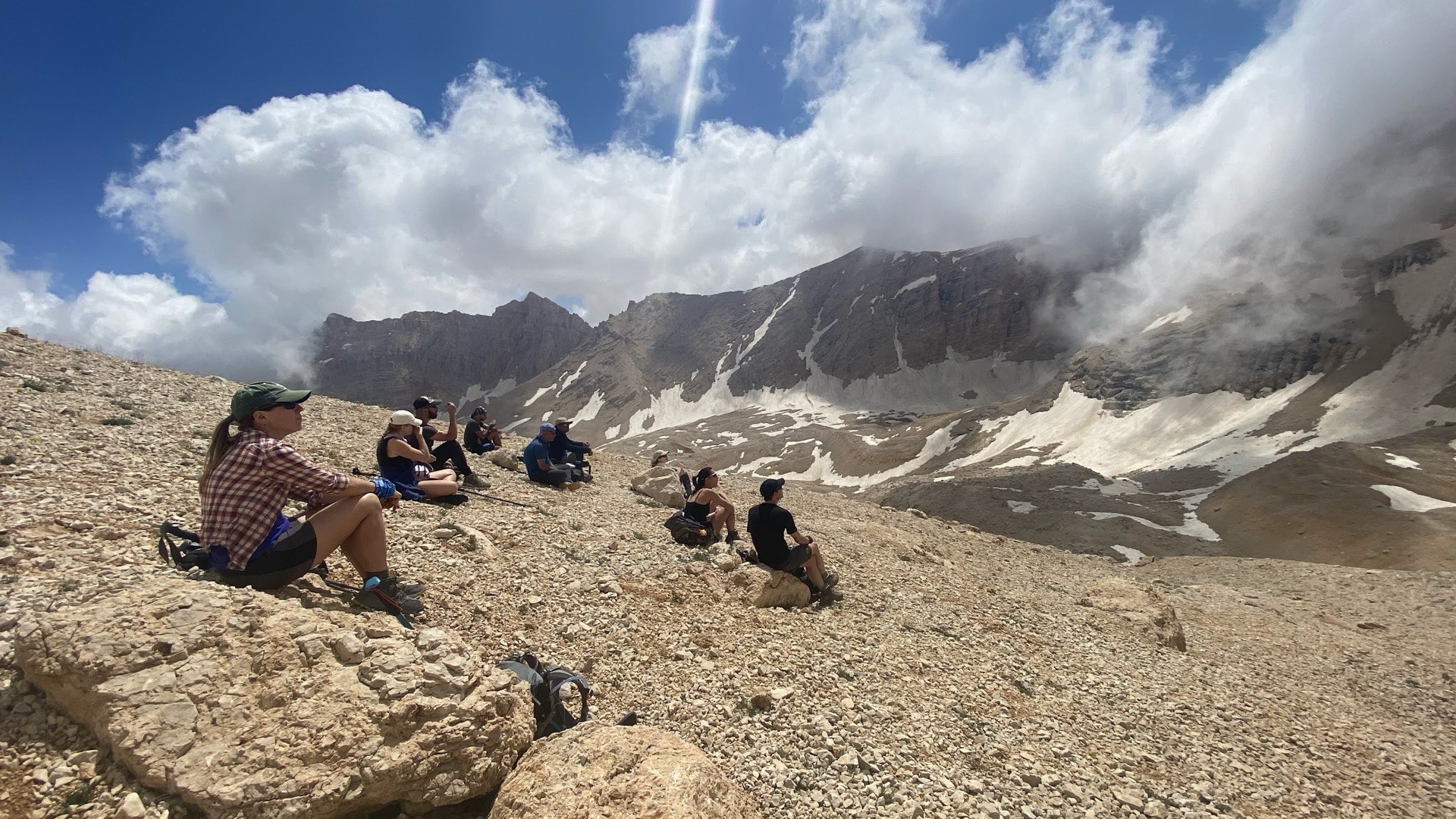
It is the question we hear before almost every departure: what should go in the pack? The answer depends less on a list than on the trip you choose. On our guided trips and on our self-guided ones alike, luggage is moved from one overnight stop to the next, so you only ever carry a daypack. What changes from one trip to another is the ground under your boots, the temperature at six in the morning, and what you will or will not find at the end of the trail. The sections below go region by region, from Cappadocian tuff to the Ararat glacier.
What gear do you need for which trek in Türkiye?
Our catalogue falls into four broad families of trips, and they do not call for the same pack. In Cappadocia you walk through valleys of volcanic tuff on a plateau more than a thousand metres above sea level, with small tunnels, sandy stretches and cool nights for much of the year. On the Lycian coast, limestone rules: loose stones, old mule tracks, long descents to the coves, and heat that builds quickly from late spring onwards.
In the Aladağlar, the Cappadocia and Taurus programme follows gorges and mountain valleys: the descent through the Emli valley is listed at −940 m, and the Cimbar canyon has one short section where you use your hands, with no exposure. On Ararat, finally, you sleep in tents up to 4,200 m and put on crampons for the glacier. The table below sums up what really changes.
| Trip | Terrain | Footwear | Key clothing | Don't forget |
|---|---|---|---|---|
| Cappadocian valleys (Trails of Cappadocia, Cappadocia–Istanbul) | Tuff, fine sand, rock-cut steps, small tunnels | Low or mid-cut boots with a lugged sole | Fleece and windproof for mornings and evenings | Headtorch, a scarf against the dust |
| Lycian coast (Lycian Way self-guided, Antalya–Kekova) | Sharp limestone, loose stones, long descents | Hiking boots with a stiff sole and good ankle support | Light long-sleeved shirt, wide-brimmed hat | Swimsuit, poles for the descents, spare water |
| Taurus canyons (Cappadocia and Taurus) | Mountain paths, gorge floors, scree | High-cut boots with good grip | Warm layer, waterproof jacket | Poles, light gloves for the Cimbar section |
| Ararat (Artos–Ararat) | Pasture, volcanic rock, glacier from about 4,750 m | Stiff, crampon-compatible mountain boots | Down jacket, hat, warm gloves, overtrousers | Warm sleeping bag, glacier glasses, headtorch |
| Caria (Latmos and gulet) | Mule tracks, igneous rock, coastal paths | Mid-cut boots with a grippy sole | Light clothing, windproof for the deck in the evening | Soft bag, sandals that stay on your feet |
What goes in the daypack when your luggage travels by vehicle?
Luggage transfers are part of every one of our trips in Türkiye, guided or self-guided. Your main bag leaves the guesthouse in the morning and is waiting for you in the evening at the next stop. In between, you have only your daypack. A volume of 20 to 30 litres is enough in the vast majority of cases; anything larger tends to get filled.
On a guided trip, the picnic lunch is part of full board and the guide knows where to find water. On a self-guided trip, the option you booked decides: breakfast only, half board or full board. If your option does not include lunch, ask the guesthouse the evening before what they can prepare, or stop at the village grocery before setting off. In the ridge hamlets, between Alınca and Gey for instance, do not count on finding a shop open at midday.
What stays in the daypack, whatever the trip:
- the day's water and a salty snack;
- a warm layer and a waterproof jacket, even if the morning is fine;
- hat, sunglasses, sunscreen;
- a small personal first-aid kit and your usual medication;
- passport or a copy, and some cash in Turkish lira for tea or a drink in a village;
- a charged phone, power bank and cable;
- a headtorch, even for a short stage;
- a waterproof pouch for documents and one dry layer.
On the Lycian Way self-guided trip, the route book and GPS tracks are provided. Download the tracks and the map for offline use before you leave: the signal is patchy in the side valleys between Faralya and Kabak. Keep the paper route book within reach rather than at the bottom of your main bag. And never put medication you cannot do without in the transferred luggage: a vehicle can be held up on a dirt track.
Which boots for Lycian limestone, Cappadocian tuff and the Taurus canyons?
This is the one purchase we insist on. In Lycia the limestone is hard, often sharp, and the paths switch between smooth slabs and rolling stones. The descents take more out of you than the climbs: on the Chimaera, Kekova and Termessos trip, the Alınca–Faralya stage is listed at 720 m of descent for 170 m of ascent, and the walk down from Kozağaç to Ölüdeniz at 480 m of descent. You need a stiff, deeply lugged sole and an upper that holds the ankle. Trail-running shoes suit experienced walkers, rarely anyone else.
In Cappadocia the volcanic tuff is softer. In dry weather it is covered in fine dust that slides on slopes, a little like sand on concrete. After rain, valley floors turn sticky and the rock-cut passages become slippery. A low or mid-cut hiking boot with a grippy sole does the job on the four-to-six-hour days of Trails of Cappadocia. In the small tunnels of Meskendir you will be glad of a sole that does not skid on damp rock.
In the Aladağlar we recommend high-cut boots. The long descent of the Emli valley and the scree slopes are hard on the ankles, and the floor of the Cimbar canyon means stepping from block to block. For Ararat, boots must be stiff, warm and take crampons; if you plan to borrow crampons on site, have the fit confirmed before departure.
Three rules apply everywhere. Boots that are broken in, meaning worn on several outings with some climbing before the trip. Two pairs of wool or synthetic walking socks to alternate. And a pair of light sandals for the evenings, beaches and river crossings. Telescopic poles help in every region, above all on descents; pack them in your checked baggage, as they are often refused in the cabin.
What clothes should you bring for each season and region?
The principle is layering: a breathable T-shirt, a fleece or light down jacket, and a waterproof, windproof shell. Take off, put back on. Cotton dries slowly and chills you at every break; leave it for town.
Cappadocia is a continental plateau. In spring and autumn the walking days are pleasant, but the cold comes down fast at sunset and mornings are fresh, sometimes properly cold late in the season. In summer the sun beats down on shadeless ridges. In winter, snow and frost are possible. A hat and light gloves weigh nothing and are often useful at the start of a stage, even in May.
On the Lycian coast, our trips run from April to June and from September to October, precisely to avoid the heat of high summer. Even then, an afternoon on an exposed slope can be hot. We prefer a light long-sleeved shirt and thin walking trousers to a vest top: they protect against the sun and the thorny scrub of the maquis. In April a shower is always possible, so a rain jacket earns its place. Hill villages such as Yaylakuzdere or Ulupınar are cooler in the evening than the coast.
In the Taurus, from May to October, there is a marked difference between the gorge floors and the plateaus. On Ararat, from July to September, nights at base camp can come close to freezing, and the summit push starts in the dark, in the cold and often in wind. To choose dates with these contrasts in mind, see our article on when to go hiking in Türkiye.
How much water should you carry, and how do you deal with the sun?
There is no quantity that suits everyone. As a guide, we suggest at least 1.5 litres for a cool day in Cappadocia, and 2 to 3 litres for an exposed stage on the Lycian coast in warm weather. The right amount depends on how much you sweat, when you start and how much shade there is. Better to carry an extra half-litre than to finish the descent with empty bottles.
Do not build your day around a fountain you are not sure of. Some springs dry up at the end of summer, and a village tap can be turned off. With a guided group, the guide knows the day's water points; on a self-guided trip, the route book shows them, but the safe approach is still to leave with full supplies. Several of our programmes include mineral water with meals, and on Ararat water and tea are served at every meal and on arrival at camp.
Two one-litre bottles are easier to refill than a hydration bladder and let you see what is left. A bladder has the advantage of making you drink more often. Choose whatever keeps you drinking regularly.
As for the sun, a brimmed hat does more than a cap: it covers the back of the neck and the ears. Category 3 sunglasses are fine in Lycia and Cappadocia; on the Ararat glacier the glare calls for proper glacier glasses. Bring a high-factor sunscreen and a lip balm. In hot weather our guides bring the start time forward to walk before the heat; on a self-guided trip, do the same.
Ararat: what the camps provide and what you bring yourself
The Artos–Ararat programme includes four nights in private camps: two-person tents, mattresses and all the cooking equipment. A local team of drivers, muleteers and cooks travels with the group. Above the trailhead, luggage goes onto pack animals and you carry only your daypack. The group also has a portable hyperbaric chamber, a pulse oximeter and a first-aid kit. Crampons and an ice axe can be lent if needed, and the guide goes over how to use them on day 6, before the climb to high camp.
On day 3, in Doğubayazıt, anything you will not need on the mountain can be left in a room reserved for the group. That is the moment to sort things out: town clothes on one side, camp kit on the other.
What you bring yourself:
- a warm sleeping bag; we suggest a comfort rating well below zero, around −10 °C, for sleeping at 4,200 m;
- a thick down jacket, a hat, a balaclava or neck gaiter, and two pairs of gloves, one of them warm;
- waterproof overtrousers and gaiters;
- stiff, crampon-compatible mountain boots;
- glacier glasses and high-protection sunscreen;
- a headtorch with spare batteries: the summit push starts at around 3 a.m.;
- a thermos or insulated bottle, as water freezes quickly at night.
If you would like a tent to yourself, that is a supplement to request when booking. For fitness and acclimatisation, our Mount Ararat ascent guide goes through the stages.
Boat days: Kekova, Maden and the Carian gulet
Several trips combine walking and sailing. On Antalya–Kekova, on day 11 you board a traditional wooden boat in Sıcak bay, with lunch on board and a swim, before returning to Üçağız by sea. On Chimaera, Kekova and Termessos, the return from Maden bay to Çıralı on day 2 is by boat. The Latmos and Mediterranean cruise programme includes five nights aboard a gulet, in double cabins with shower and toilet, and landings on beaches such as Ölüdeniz.
For these days, slip a swimsuit, a quick-drying towel and a waterproof phone pouch into the pack. Landings sometimes mean stepping into the water: sandals that stay on your feet stop you slipping on the pebbles. In the evening on deck, the sea breeze is cooler than you might expect; keep a warm layer handy. If you are prone to seasickness, bring your usual remedy.
On the gulet, a soft bag stows far more easily than a hard suitcase in a cabin. Ask in advance what replaces the sailing if the sea rules it out; the FAQ also answers several practical questions of this kind.
Villages and guesthouses: how to behave
Most of our nights are spent in village guesthouses or small boutique hotels. On the trail, shorts are no problem at all. In guesthouses, shoes often come off at the door: light sandals or clean socks for the evening make the house more comfortable.
Ask before photographing anyone, especially older women in the fields or in front of their houses. A cup of tea when offered is gladly accepted; on the Carian programme, the walk through a village of goat and sheep farmers is sometimes the occasion for a welcome tea. A few words of Turkish are enough: "merhaba" to greet, "teşekkürler" to thank, and "içilir mi?" at a village fountain to ask whether the water is drinkable.
Finally, a small bag to carry your rubbish out belongs in every daypack. In the coves of Lycia as in the valleys of Cappadocia there is not always a bin, and what is left behind stays there a long time.
First-aid kit, and what you can leave at home
A light personal kit is enough in most cases. We suggest blister plasters, antiseptic, a painkiller, something for stomach upsets, rehydration sachets, an antihistamine and a tick remover. Add your personal medication in sufficient quantity, with the prescription. Pharmacies, called "eczane", are found in towns and larger villages, rarely in hamlets.
What we often see come home unused: jeans, too heavy and slow to dry; too many cotton T-shirts; a thick paper guidebook; a second pair of walking boots; valuables. Knives and sharp objects go in the hold, never in the cabin. On a self-guided trip the route book replaces most reading; on a guided trip, the guide answers questions on the trail.
Our basic list for the main bag, to adapt:
- broken-in walking boots and light sandals;
- two or three breathable T-shirts, one long-sleeved shirt;
- walking trousers, shorts or zip-off trousers;
- a fleece, a light down jacket, a waterproof jacket;
- hat and light gloves, even in spring;
- swimsuit and microfibre towel;
- a clean outfit for the evening;
- wash bag, first-aid kit, headtorch, poles;
- plug adapter and power bank.
To compare the formats, see our pages on guided trips and self-guided trips. For the stages themselves, our guides to the Lycian Way and the Cappadocian valleys complement this article, as does our trek comparison. All our hikes in Türkiye are gathered on one page, and remaining practical questions are often answered in the FAQ.