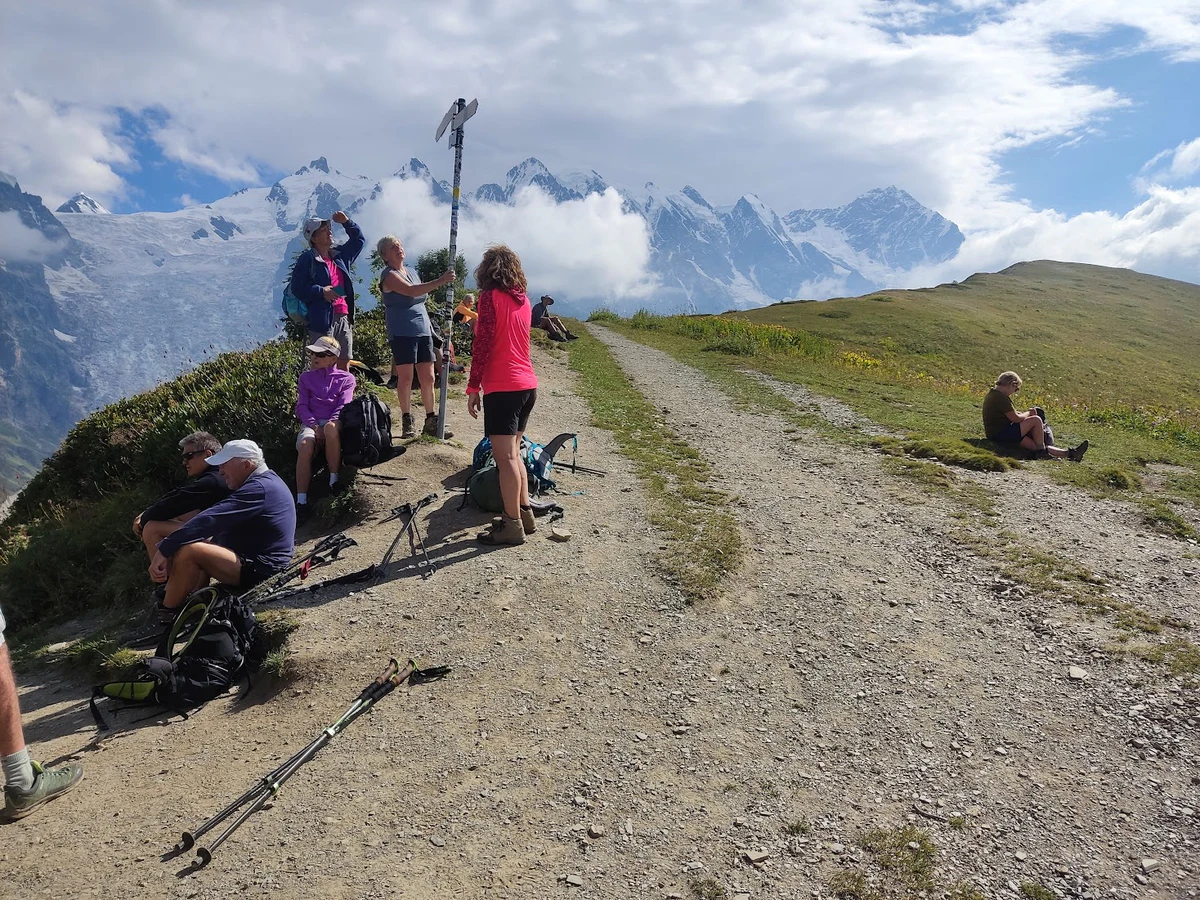
Svaneti is a high valley of the Greater Caucasus in north-west Georgia, where every village bristles with stone towers. Between Mestia and Ushguli, a trail links those villages across meadows, forests and a pass facing the glaciers. It is one of the finest treks in the Caucasus and one of the most accessible. This guide gathers what you need to know to prepare it, based on the two trips we run there. The whole region is on our Georgia page.
What is the Svaneti trek between Mestia and Ushguli?
Upper Svaneti has been a UNESCO World Heritage site since 1996, for its medieval villages and defensive towers preserved in a mountain landscape. Mestia is its small capital: a spread-out town whose old centre has many well-preserved towers. Ushguli, at the other end, is a group of hamlets below Mount Shkhara, which the Georgian tourism board describes as the highest village in Svaneti. By road they are about fifty kilometres apart.
On foot, the classic trek has four stages: Mestia–Zhabeshi, Zhabeshi–Adishi, Adishi–Khalde over the Chkhunderi pass, and Khalde–Ushguli. You sleep in a village every night, with a family or in a guesthouse. There are no mountain huts and no camping is required, and you carry only a daypack if your luggage goes by road.
The trek is part of a longer route, the Transcaucasian Trail, which crosses Upper Svaneti over about 140 km from Chuberi. Its sections are waymarked red-and-white or yellow-and-white, with yellow direction signs.
There are two gateways to Svaneti: Kutaisi airport in the west of the country, the closest, and Tbilisi, the capital. From the lowlands the road climbs via Zugdidi and the Enguri valley to Mestia. Allow a day of travel to reach the mountains, which is why both our programmes use their first day for arrival and a night in town.
The stages day by day
Both our trips walk the trek from Ushguli to Mestia, after a first day from the Zagari pass. The table uses the figures from the Svaneti – Great Caucasus Traverse programme.
| Stage | Distance | Up / down | Walking time | Stated difficulty |
|---|---|---|---|---|
| Zagari pass → Ushguli | 10.3 km | +716 m / −1,167 m | about 4 h 40 | Moderate |
| Ushguli → Khalde | 15.3 km | +627 m / −654 m | about 6 h 05 | Difficult |
| Khalde → Iprari → Chkhunderi pass → Adishi | 14.2 km | +681 m / −653 m | about 5 h 25 | Difficult |
| Adishi → Zhabeshi | 10.3 km | +429 m / −907 m | about 3 h 50 | Moderate |
| Zhabeshi → Mestia | 15.7 km | +386 m / −633 m | about 4 h 50 | Moderate |
| Mestia → Guli pass → Mazeri | 14.2 km | +548 m / −1,361 m | about 6 h | Difficult |
Source: Svaneti – Great Caucasus Traverse programme. The four central stages, Ushguli to Mestia, add up to 55.5 km. Our 13-day programme gives slightly different climbs for the same days: figures vary with the exact starting point and variant.
These are walking times. With breaks, photos and lunch, expect a full day, especially for Khalde–Adishi.
Which direction: Ushguli to Mestia or the other way?
Most independent trekkers start in Mestia, which is easier to reach, and finish in Ushguli. We do the opposite, for reasons of terrain and logistics.
- Arriving over the Zagari pass. You enter Svaneti from above, on foot, facing the glaciers, instead of reaching Ushguli by vehicle on a long track.
- Nights that get lower. Ushguli is at about 2,100–2,200 m, Mestia at about 1,500 m. In this direction your body never has to adapt to sleeping higher and higher.
- Finishing in Mestia. It has hotels, restaurants and a museum, and it is the starting point for the Guli pass day facing Ushba. It is also through Mestia that you head back down to Zugdidi and Kutaisi.
For scenery, both directions are equal. Walking Mestia to Ushguli, you save Ushguli for last; in ours, you finish with the view of Ushba.
The Chkhunderi pass and the Adishi ford: the key day
This is the day everyone talks about. From Khalde, the trail climbs to the hamlet of Iprari and then the high pastures before going up to the Chkhunderi pass, at about 2,700 m (2,720 m according to our 13-day programme). From the pass, the view opens onto the Tetnuldi massif, the crests of the Greater Caucasus and the Adishi glacier.
The descent leads to the river that flows from the glacier. There is no bridge. Depending on the water level, you ford it or, more often, cross on horseback with horses and riders from the area; our programmes organise the crossing according to the conditions on the day. Glacial water rises during the day as the ice melts, so cross in the morning rather than late afternoon. The Transcaucasian Trail warns that river crossings are dangerous at high water; never wade alone into a current above your knees.
Adishi, at the end of the stage, is an isolated, partly deserted village with its towers. With the pass, the river crossing and the breaks, you usually get there in the late afternoon.
When to go to Svaneti
Our Svaneti treks run from mid-June to mid-September; that is the window we give for the 13-day trip. Earlier, snow can still cover the passes and rivers are swollen with meltwater; later, the first snow can return to the heights and nights turn cold.
- Late June and July: flowering meadows, long days, high rivers, sometimes snow patches near the passes early in the season.
- August: the height of summer and the busiest time on the trail and in guesthouses.
- Early September: quieter trails, softer light, cool mornings.
In summer, mountain thunderstorms are frequent. The Transcaucasian Trail warns of summer storms with intense lightning: start early, cross the passes in the morning and do not linger on ridges when the sky builds. Bring a waterproof jacket and a warm layer, even in August.
Staying with local families: guesthouses, meals, comfort
On the trek you sleep with local families or in guesthouses. That is a big part of the pleasure: dinner is at the family table, with Svan dishes such as kubdari, a meat pie, and the famous Svan herb salt. In the morning you take a picnic prepared by the house.
Comfort is simple, and we prefer to say so clearly. In the villages, the 13-day programme specifies shared showers and toilets and rooms to share. In Mestia and the towns, nights are in three-star hotels. Mobile coverage is patchy between villages: tell your family you will sometimes be out of reach.
The Svans have their own language, spoken at home alongside Georgian. Hospitality is warm, but these are family homes, not hotels: fit in with dinner times and let your hosts know if you will arrive late.
Beyond the trek: the Guli pass, Ushba and the Koruldi lakes
If you have one more day in Mestia, keep it for the Guli pass. For many it is the best day of the trip. On our 9-day programme you set off on foot from Mestia: a steady climb through forest and then meadows, views of Ushba (4,710 m), then a long descent into the Becho valley to Mazeri, where a vehicle takes you back to Mestia. The programme gives 14.2 km, +548 m and −1,361 m.
The 13-day trip does the same day differently: a 4×4 transfer to the Koruldi lakes above Mestia, then a trail to the Guli pass (2,950 m according to that programme) and down to Becho. The very long descent is the real difficulty of the day: trekking poles take a lot of strain off your knees.
Level, safety and 112 in Georgia
The trek has no technical passages, but it is not a stroll. Our two programmes are graded 2/5 and 3/5; in detail, three stages of the 9-day trip are described as difficult, with 5 to 6 hours of walking and long descents. You should be comfortable with several consecutive mountain days.
The hazards to know about, as described by the Transcaucasian Trail, are concrete: steep terrain, sometimes tricky route-finding, river crossings at high water, aggressive livestock dogs, giant hogweed (a tall plant whose sap burns skin in sunlight) and summer thunderstorms. The same organisation points out that emergency medical care and search and rescue are not always available in the mountains.
In Georgia the emergency number is 112, as in Türkiye. The official "112 Georgia" app lets you call, chat with the emergency centre or send a silent alert with your location. Install it before you go, and remember that coverage can drop between villages. For other field precautions, see our guide water, heat and safety on the trail and our list what to pack.
Two trips, two rhythms: 9 or 13 days
Svaneti – Great Caucasus Traverse (9 days, level 2/5) keeps to the essentials. Arrival in Kutaisi, a drive to the Zagari pass and a first walk to Ushguli, then Khalde, Adishi, Zhabeshi and Mestia on foot, the Guli pass day, and the return to Kutaisi with a visit to Prometheus Cave. Three-star hotels in Kutaisi and Mestia, family homes or guesthouses in the villages.
Trekking in Svaneti – Georgia (13 days, level 3/5) adds Georgia’s cities. Two days in Tbilisi, Gori and Kutaisi, Prometheus Cave, then the trek from Zagari to Mestia via Ushguli, Khalde, Adishi and Jabeshi, the Koruldi lakes and Guli pass day, and finally two days in Batumi on the Black Sea.
In both cases the group has 4 to 15 people, with a local hiking guide who speaks your group’s language, full board except on the first and last days, and luggage transfers. For questions about flights, formalities or insurance, see our FAQ. And if you are weighing it against a trek in Türkiye, read which trek to choose: autumn, when Svaneti closes, is the best season on the Turkish coast and in Cappadocia.
Stages, distances, climbs and inclusions: the Aventures Anatoliennes programmes listed. Heritage: UNESCO. Road distance and Ushguli: Georgian National Tourism Administration. Waymarks and hazards: Transcaucasian Trail.