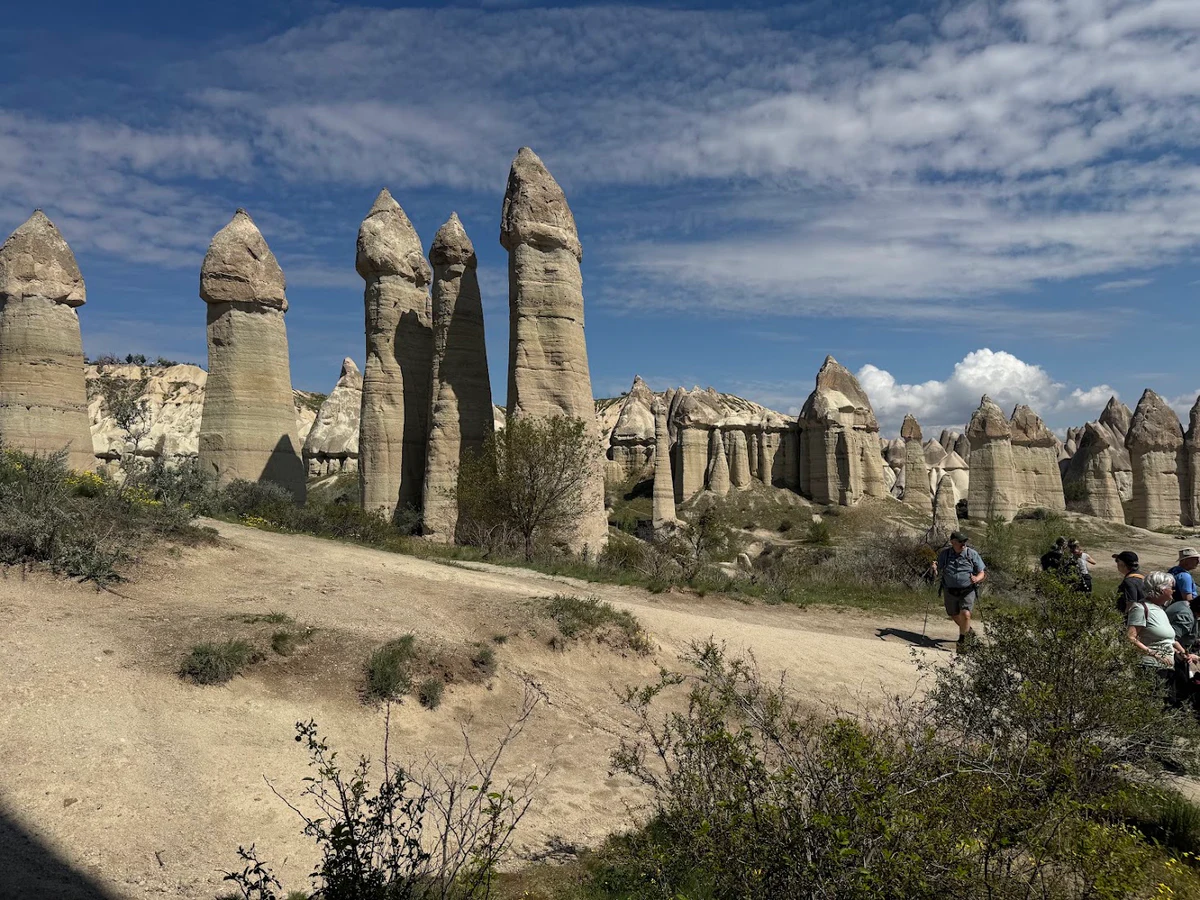
Cappadocia receives huge numbers of visitors every year, yet most of them hardly ever set foot in a valley. They see the viewpoints, the Göreme Open-Air Museum, Paşabağ, a balloon at sunrise. A few hundred metres from those places, the trails are often empty. This guide explains where to walk, at what time, and how our itineraries are built for it. For seasons and a general choice of valleys, see also when to hike in Cappadocia and which valleys to choose.
Where to hike in Cappadocia to avoid the crowds
Crowds follow the road. Coaches and minibuses stop where they can park: the Uçhisar and Göreme viewpoints, the open-air museum, Paşabağ, Zelve, the main entrance to Ihlara, the underground cities of Derinkuyu and Kaymaklı. Between those stops, the landscape belongs to walkers.
The Cappadocia that matters to a hiker is a plateau of volcanic tuff cut up by erosion. UNESCO listed it in 1985 as "Göreme National Park and the Rock Sites of Cappadocia". The valleys form a tight network: you move from one to the next over a ridge, through a tunnel dug by former inhabitants, across an apricot orchard. That network is what lets you escape: as soon as you leave the axis of a famous valley for its neighbour, the noise drops.
Three simple rules shape our itineraries:
- enter a well-known valley from the top or from a side valley, not from the car park;
- cross the busiest sections when the groups are elsewhere;
- sleep in a valley village, Mustafapaşa or Çavuşin, rather than among the hotels of Göreme.
That leaves the Göreme Open-Air Museum, which many people want to see anyway. Its painted churches deserve a visit, but the chapels are small and queues build quickly. Our rule of thumb: go in at opening time or late in the afternoon, and spend the rest of the day in the neighbouring valleys, where the same monks carved churches that almost nobody visits.
Sunrise balloons: see them without the scrum
The balloons take off around sunrise, when the air is still, and stay up for about an hour. Flights depend on the wind and are cancelled on some mornings, especially in winter and spring. People who have booked a flight on a fixed date sometimes find this out several days running.
For walkers, the show is free. The balloons drift over the valleys around Göreme, Çavuşin and Uçhisar, often low. From a guesthouse terrace in Çavuşin, or from the first stretch of the White Valley, you watch them pass above the fairy chimneys without joining the crowds of photographers on the ridges.
A tip from the field: if you want to walk at dawn, choose a valley you already know, or go with a guide. In half-light, tuff paths look alike, and some valley floors are cut by narrow passages. Our programmes start after breakfast; we watch the balloons before.
What time for which valley?
The table sums up our benchmarks. They are patterns we see season after season, not guaranteed timings: a Turkish public holiday, a spring weekend or several groups arriving at once can upset them.
| Area | Quiet time | Busy time | Why | In our trips |
|---|---|---|---|---|
| Gomeda, Keşlik, Golgoli (south, around Mustafapaşa) | Most of the day | Rarely | Away from standard day-tour circuits | Trails of Cappadocia, self-guided, Cappadocia & the Lycian Coast |
| Meskendir, Güllüdere (Rose), Kızılçukur (Red) | Late morning, early afternoon | Sunset, on the ridges and tracks | The evening panorama draws vehicles and groups | Trails of Cappadocia (day 5), self-guided, Cappadocia – Istanbul, Cappadocia & Taurus |
| White Valley (Akvadi), Pigeon Valley | Morning | Around Uçhisar at midday | The Uçhisar viewpoints sit at the end of the trail | Trails of Cappadocia (day 6), Cappadocia – Istanbul, Cappadocia & Taurus |
| Zelve, Paşabağ | Early morning, late afternoon | Midday | Day-tour stops | Trails of Cappadocia (day 7), Cappadocia – Istanbul |
| Ihlara canyon | Stretches away from the main access points | Around the main entrance | Most visitors walk only a short part of it | Trails of Cappadocia (day 4), Cappadocia & the Lycian Coast |
| Bozdağ plateau | All day | Rarely | Off the vehicle-tour circuits | Trails of Cappadocia (day 7), self-guided |
The southern valleys: Gomeda, Keşlik, Golgoli, Mustafapaşa
This is our favourite starting point, and it is no accident that three of our programmes spend their first nights here. Mustafapaşa, the former Sinasos, was home to Greek Orthodox families until the population exchange of 1923. Its carved stone houses set the tone: here, Cappadocia is first of all a country of villages.
Around it, paths wind between vines and apricot trees. The rock-cut monastery of Keşlik, dated by our programmes to the 10th century, sits in a quiet side valley. Further on, the cave dwellings of Golgoli are hollowed out of tuff cones; we picnic in the shade of their walls. On Trails of Cappadocia, this day is 4 to 5 hours of walking with +381 m and −345 m.
The Gomeda (or Gömede) valley is a maze of monasteries, dovecotes and narrow passages. We cross it towards Ortahisar, the village below its rock fortress. The programme gives 4 to 5 hours, +230 m and −340 m. Over a whole day, you may meet only a shepherd, a farmer on his tractor and one other small group.
The Cappadocia & the Lycian Coast trip adds the underground city of Mazı, less visited than Derinkuyu or Kaymaklı, and the Uzengi valley with its orchards and dovecotes.
Meskendir, Güllüdere, Kızılçukur: crossing the heart without following the flow
The Rose (Güllüdere) and Red (Kızılçukur) valleys are the most famous, and they deserve it: coloured cliffs, white streaks, rock churches, tunnels. They are also crossed by tracks used, especially late in the day, by quad bikes and 4×4s. Sunset over the Red Valley has become an event.
Our approach: enter by Meskendir, still little used, with its small tunnels, then reach Güllüdere and Kızılçukur in the late morning. Lunch is in the heart of the Red Valley, when day-tour groups are at their restaurants. In the afternoon we walk out towards Çavuşin before the evening vehicles arrive. On Trails of Cappadocia, the day is 5 to 6 hours, +339 m and −490 m.
In Çavuşin, the old village leans against a cliff riddled with dwellings, with the church of St John the Baptist above. Three of our programmes spend several nights here: it is the right place to set off on foot in the morning without getting back into a vehicle.
Ihlara, Selime, Derinkuyu: planning canyon day
The Ihlara canyon is another Cappadocia: a green gorge floor, the Melendiz river, cliffs up to 150 m high according to our programme, and churches with coloured frescoes (the Church under the Tree, the Hyacinth Church). The trail runs for about 14 km.
Most visitors go down by the main entrance, walk a stretch and climb back out. Walking a little further, or starting from the other end, is enough to find peace. On Trails of Cappadocia, the day starts at the rock-cut monastery of Selime and includes 4 to 5 hours of walking, +250 m and −300 m.
The trade-off: Ihlara is some distance from the Göreme valleys. On the same day our groups visit the underground city of Derinkuyu, eight levels and 55 m of galleries according to the programme, and total driving time reaches about 3 hours. In Derinkuyu the galleries are narrow and groups follow one another; the quiet part of the day comes afterwards, in the canyon.
Bozdağ and Zelve: getting above it all
The Bozdağ plateau, above Çavuşin, is our answer to anyone who asks for a summit in Cappadocia. A balcony path circles the plateau and leads to its high point, with a view over the whole region. Tour vehicles do not go up there, and you walk for a long time without meeting anyone.
The descent follows the Zelve valley, a former cave village, down to the chimneys of Paşabağ, the "Monks’ Valley" or "vineyards of the Master". On Trails of Cappadocia, the day is 5 to 6 hours, +500 m and −500 m. We reach Paşabağ late in the day, after the coaches have left; at midday the site is very busy.
Which season for a quieter Cappadocia?
Cappadocia can be walked all year; two of our programmes, Trails of Cappadocia and Cappadocia – Istanbul, have no closed season. For month-by-month figures, see Hiking in Cappadocia: choose the right valleys and plan the day.
As for crowds, long weekends and Turkish religious holidays (whose dates change every year) fill the region with domestic visitors. Outside those periods, a Tuesday in October has nothing in common with a Saturday in May.
Guided, self-guided or combined?
For a first visit, Trails of Cappadocia (8 days, level 2/5) links everything above with a Turkish guide who speaks your group’s language: Keşlik and Golgoli, Gomeda, Ihlara, Meskendir and the Rose and Red valleys, the White Valley, the Bozdağ. Cappadocia, Call of the Hidden Valleys offers a similar self-guided week, level 3/5, with a route book and GPS tracks, based in two guesthouses in Mustafapaşa and Çavuşin.
To combine Cappadocia with something else: Cappadocia – Istanbul adds three days in the city, Cappadocia & Taurus heads down to the gorges of the Aladağlar, and Cappadocia & the Lycian Coast continues to the Mediterranean. The whole region is on our Cappadocia page, practical questions in our FAQ, and autumn in Türkiye in hiking in Türkiye in October and November.
Times and climbs: the Aventures Anatoliennes programmes listed.